APOD

Astronomy Picture of the Day

Discover the cosmos! Each day a different image or photograph of our fascinating universe is featured, along with a brief explanation written by a professional astronomer.
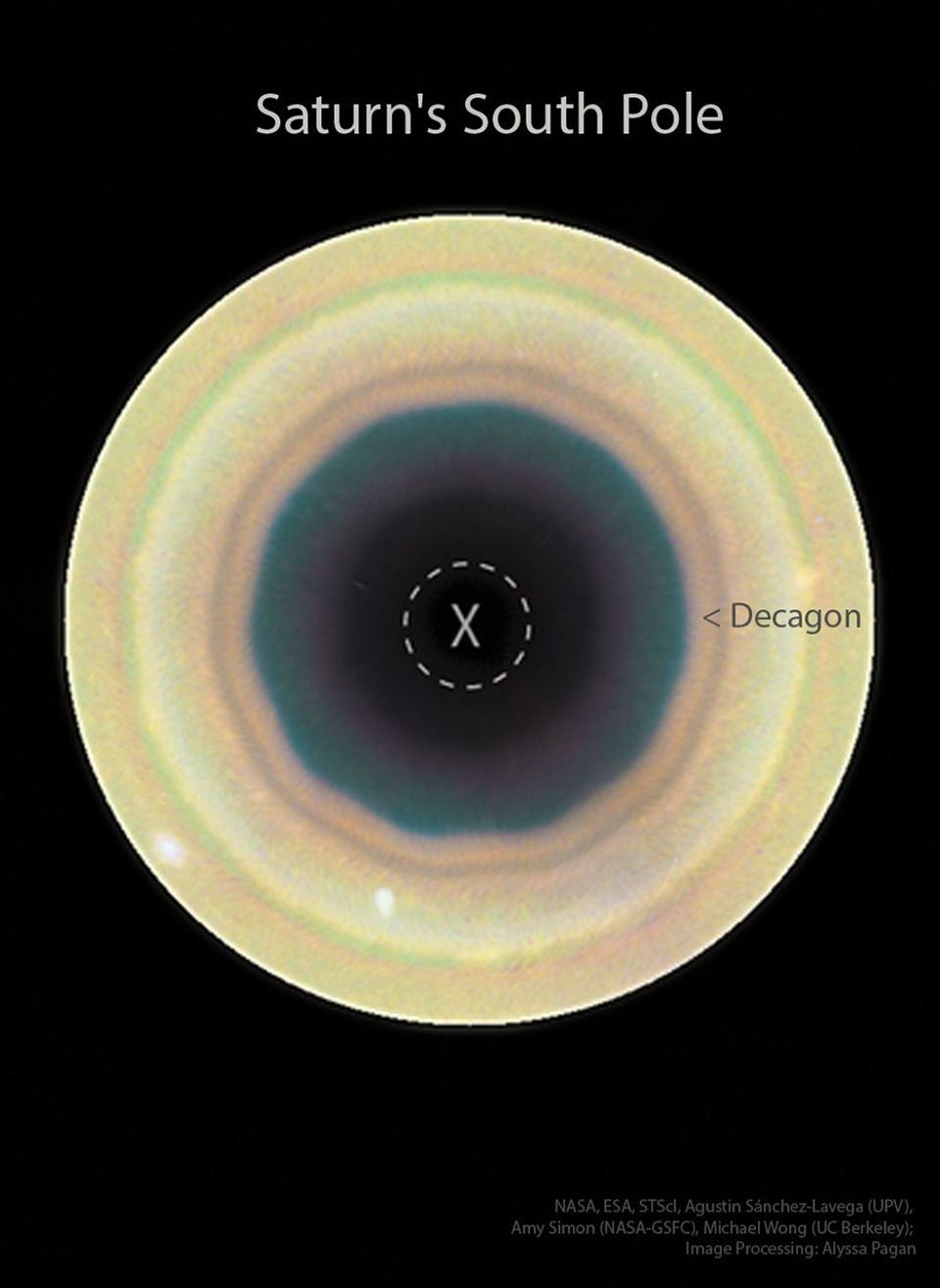
A dark field has a bright circular disk near the center. Around the center of this disk are bands. One of the bands  appear particularly geometric and appears to have 10 sides. Please see the explanation for more detailed information.

Hubble: Decagon Around Saturn’s South Pole

Explanation: Why are Saturn’s poles geometric? Saturn’s North Pole has been known to be surrounded by a hexagonal (6 sides) cloud since discovery in 1987 in data taken by NASA’s Voyager spacecrafts, which quickly flew past the ringed world in the early 1980s. Now, recent observations of Saturn by the Hubble Space Telescope reveal a slightly different geometric cloud pattern around the South Pole: a decagon (10 sides). The geometric boundaries are possibly caused by waves when the fast-moving gas away from the poles interacts with slower-moving gas closer to the poles. In the featured image composite by the Hubble taken last year, the South Pole of Saturn is marked by an X and surrounded by bands of circulating clouds. The decagon appears most prominent in the dark inner regions. The northern hexagon has proven stable for over 40 years, while the stability of the southern decagon will surely remain a topic of research.

APOD’s main NASA site is moving: From apod.nasa.gov to science.nasa.gov/apod
Tomorrow’s picture: open space

Date September 8, 2026
Credit NASAESASTScIHSTA. Sánchez-Lavega (UPV), A. Simon (NASA-GSFC), M. Wong (UC Berkeley); Processing: A. Pagan (STScI)
Authors & editors: Robert Nemiroff, Jerry Bonnell, Cecilia Chirenti, Keighley Rockcliffe
A service of: ASD at NASA / GSFC,
NASA Science Activation & Michigan Tech. U.

Source: science.nasa.gov

Leave a Reply

Your email address will not be published. Required fields are marked *

Related Posts

NASA Technique for Manipulating Satellite Photos Now Reveals Ancient Images  

3 min read Preparations for Next Moonwalk Simulations Underway (and Underwater) Jon Harman poses in front of an example of the Rancho...

Read out all

1,000 Museum Visitors Dive Into NASA Sea Level Science on World Ocean Day

Explore This Section Science Science Activation 1,000 Museum Visitors Dive… Overview Resources Opportunities Citizen Science Highlights About Science Activation   3 min...

Read out all

NASA’s Hubble, Webb Find Far-out Solar System Objects ‘Remember’ Past

Explore Hubble Science Hubble Space Telescope NASA’s Hubble, Webb Find… Hubble Home Overview About Hubble The History of Hubble Hubble Timeline Why...

Read out all

The Otherworldly Geology of Vasquez Rocks

Earth Observatory Science Earth Observatory The Otherworldly Geology of… Earth Earth Observatory Image of the Day EO Explorer Topics All Topics Atmosphere...

Read out all

Superbubble in the Large Magellanic Cloud

NASA, ESA/Hubble, D. Gouliermis NASA’s Hubble Space Telescope captures a photogenic nebula, N44, in the Large Magellanic Cloud in this Sept. 3,...

Read out all

APOD: 2026 September 7 – The Pelican Nebula in Gas, Dust, and Stars

APOD Science APOD APOD: 2026 September 7 – The… Today’s APOD Archive Submissions Index Search Calendar RSS Education About Discuss   APOD...

Read out all